Landlords Unite.
For those of you with long memories, may remember 1974 as the year that Ted Heath called a General Election based on ‘who runs the country’ following the 1973-74 three-day week.
1974 also marked 9 years since the Rent Act 1965 introduced regulated tenancies with ‘fair rents’ set by independent rent officers. This was a time when it was most difficult for a landlord to make enough return on their investment to earn a living, and more importantly, sufficient returns to maintain their properties.
Consequently, the Private Rented Sector (PRS) went into serious decline, with only the most determined landlords willing to battle on.
Ten years previously (23 October 1963) the ‘Property Council’ was formed to represent the interests of larger landlords and property developers. In 1974 it changed its name to the British Property Federation (BPF), and Mike Stimpson, an early member of iHowz, was elected a member of the BPF residential committee in the early years of that organisation. Today BPF is a very influential organisation with Government.
Those individual, smaller landlords who remained in the sctor were a disparate group, with very little contact between them.
Brighton
Against this backdrop a Mrs. Joy Bartup wrote a letter which was published in the Brighton Evening Argus complaining about the way private landlords were treated, and especially the problems Regulated Rents were causing landlords alike. She invited like-minded landlords to attend a meeting in the ‘Marlborough Pub and Theatre’, in Princes Street, Brighton (now The Actors) – see picture. At this meeting, it was agreed that local private landlords should form an association to represent their views to Brighton Council, and to provide mutual support.
Hence the Sussex Landlord Association was born, with Ron Shrives as Hon Secretary, and a certain Mike Stimpson as a committee member. Ron and Mike worked together to build the association, typing and copying newsletters, spending many evenings stuffing envelopes to be posted, and holding landlord meetings in the Hove Conservative Club in the Methodist Church, Holland Road, Hove – see picture, as well as attended meetings with the local authority on a regular basis.
Ron remained as Secretary for [many / almost 30] years, with a 2002 article in the Argus showing him as Secretary of the renamed Southern Private Landlords Association (SPLA).
Hastings
Independently, a group of landlords had banded together in Hastings to perform the same service for landlords, but without any
formal structure.
They eventually agreed to join the newly named organisation, Sussex Landlord Association.
SOUTHAMPTON
Some years before, Roger Bell with Michael and David Thompson co-founded the Southampton Landlords Association, along with Harjap Singh, with the early meetings being held in the Gurdwara (Sikh Temple) in Southampton.
Discussions took place, and it was agreed that a larger organisation made sense, and a merger was agreed.
THE SOUTHERN PRIVATE LANDLORDS ASSOCIATION IS BORN
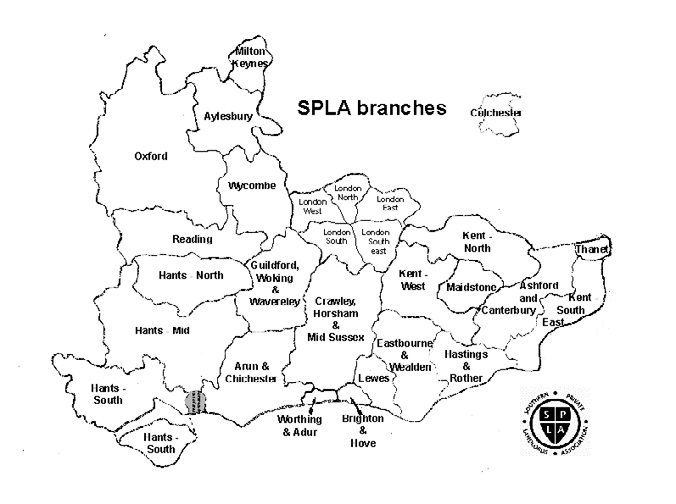
With the incorporation of Hastings, Brighton and Southampton under one banner, the name Sussex Landlord Association became
inappropriate and was changed to the Southern Private Landlords Association (SPLA). A new logo was designed by the late Barry
Cocum.
Growth was rapid during the 80s and 90’s, with the SPLA being strong in every part of the Southeast, with a full program of over 60 events per year in the early 2000’s.
This growth necessitated more administration, that is when Sally Thorne joined as the first full time employee, based in one of Mikes offices in 94 North Road, Brighton (now a tattoo parlour) managed by part time manager, Alfred Offord.
Two very important dates for the SPLA were:
August 1995, discussions took place between Barry Cocum of the SPLA and Robert Graver of Boswells Insurance (now the Alan Boswell Group) which resulted in the countries first specialised landlord insurance being launched 1st December 1995.
Early 2000’s the new Labour Government under Tony Blair started discussions on new legislation to ‘further protect tenants’.
Hence what became the Housing Act 2004 was devised under the guidance of the then Housing Minister, Keith Hill. The SPLA arranged a series of road shows comprising a mix of experts to advise landlords on the forthcoming Act, and what
they needed to know and do.
This advice, combined with the excellent insurance deal, swelled memberships numbers, and the SPLA became the largest association in the UK, standing at some 3,500 members.
Whilst the SPLA had a website, the main mechanism to keep members informed was the printed newsletter. The original newsletter produced by hand by Ron and Mike slowly developed, and eventually became the SPLA newsletter SPLASH.
OTHER ASSOCIATIONS – THE BIRTH OF THE NFRL
Naturally, the concept of landlords banding together for mutual support was not unique to the Southeast, and several other landlord
associations started across the country.
The principle one, apart from the SPLA, being the Small Landlords Association, which was started by Lillian Cline in 1973. It evolved into the National Landlords Association (NLA) in 2003, and then into the NRLA after they merged with the RLA in 2020.
The two chairs, SPLA (Mike Stimpson) and the Small Landlords Association (Geoffrey Cutting) proposed an umbrella organisation to allow many landlord associations across the country to present a unified face to Government and formed the National Federation of Residential Landlords (NFRL).
The SPLA being the larger organisation agreed
to manage it, and it grew quickly. Apart from
Mike and Geoffrey, some of the names that
were associated with the NFRL were:
Frank Hardie – East Midlands Property
Owners (EMPO)
John Stather – York Residential Landlords
Association
Derek Leach – Eastern Landlords Association
Mary Latham – Midlands
Ruth Clarke – Cornwall Residential
Landlords Association
John Sharp – Burnley
Sue Thompson – Teesside
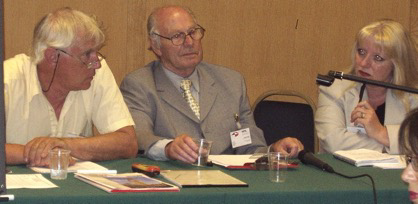
The NFRL were very active, with this
photograph showing John Stather (York) with
Frank Hardie (EMPO), and Maxine Fothergill
(SPLA) at the NRFL conference in 2005.
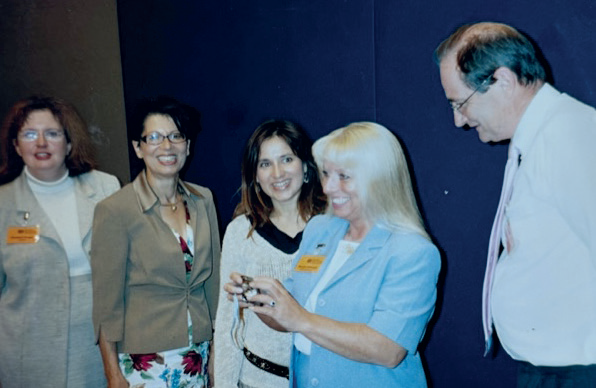
And this shows a deputation to the (now defunct) Office of the Deputy Prime Minister (ODPM). The photograph shows Alfred Offord with three of the NFRL/SPLA directors, Maxine Fothergill, Seema Bassey and Shula Rich.
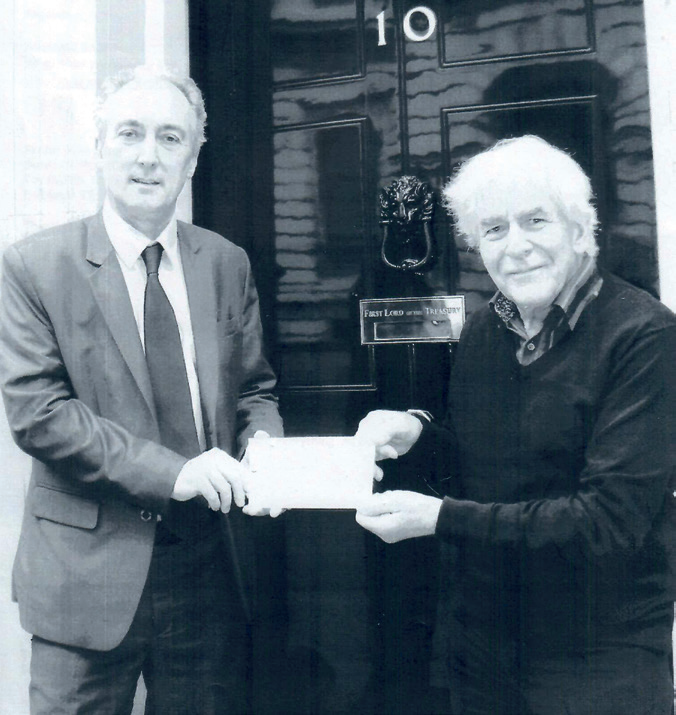
Mike Stimpson met the local MP, Mike Weatherly to present a petition to the Prime Minister (David Cameron) to incorporate
residential property into investment trust, resulting in REITS (real estate investment trust).
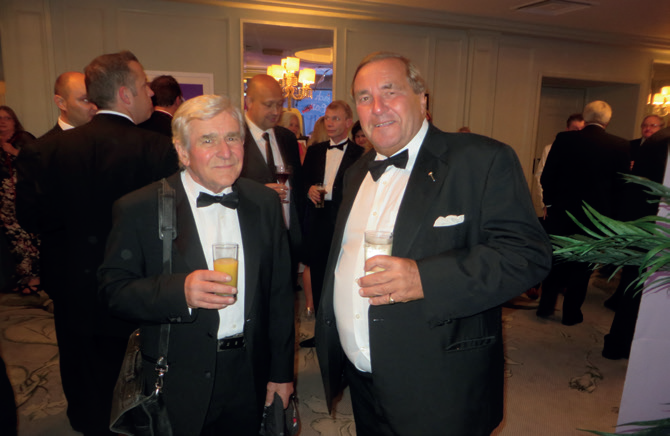
Mike and Clive Emson at a formal function. The NFRL worked together for some years with a presentation to Select Committee on Social Security May 2000, made jointly by:
- Mike Stimpson
- Gareth Hardwick – Small Landlords Association
- Mark Butterworth – the British Property Federation (BPF)
The biggest success of working together, was when a successful Judicial Review was made in the name of LANI (Landlords Association for Northern Ireland) in March 2005 where part of the 2004 Housing Act was successfully challenged. The Government were proposing that landlords would be responsible for the all the Anti-Social Behaviour (ASB) of their
tenants, and their tenants’ friends within the vicinity of the rental property. This challenge was resoundingly won on a Human Right ground, forcing a big change in the Act.
Unfortunately, attempting to keep many independent associations together proved impossible, and the Small Landlords Association, then under David Salusbury split from the NFRL to set up the National Landlords Association (NLA) in 2003.
The SPLA made every attempt to keep the NFRL running, but lack of funds from other associations meant it effectively became part of the SPLA. The NLA continued to grow, and in 2008 offered to merge with the SPLA. The majority of board members voted for the merger.
Many members did not agree with the board’s decision, and wanting the old SPLA back, and in 2009 the association was restarted; as the name SPLA had been taken in the merger, a new name had to be found fast.
Hence, the Southern Landlords Association (SLA) came into being.
However, marketing the brand proved to be difficult, with the fledgling SLA always being mistaken for the NLA, or the rapidly growing RLA. So, a rebrand came about in 2018, when the SLA became iHowz.
i for information; ‘how’ to do things correctly; in your howz (house).
iHOWZ
The inception of the landlord association iHowz proved quite different from that of the Sussex Landlord Association.
Whilst the association in 1974 had the luxury to grow organically, it was expected that SLA/iHowz would hit the road running, doing all the things the SPLA had done, but with no resources.
Additionally, the market was quite different: there were a lot more landlords, and many more rules/regulations and laws than 1974, all good things for an active membership – so you would think. We also had the internet, which we didn’t have in 1974, and for many people this was the universal panacea for finding information – why pay a landlord association when it can be obtained free?
But membership of a landlord association is so much more than getting up-to-date information and membership discounts. It’s also about funding an organisation that can stand up for members and represent their views/take on their fight.
The very best example of this is the Edwards vs Kumarasamy case in 2016.
Very, very briefly, Kumarasamy (a landlord) had a 3rd floor flat in a block. Edwards (the tenant) slipped on a paving slab outside the block and sued Kumarasamy, claiming that as landlord, Kumarasamy had a legal obligation to ‘keep in good repair the dwelling house’ etc (very much précised).
Various courts found for the tenant, which meant in theory that every landlord of a flat in a block should inspect all parts of the block on a very regular basis to ensure there were no problems.
Clearly impractical.
SLA/iHowz funded this to go to the Supreme Court, who ruled (again précised) that landlords did have a responsibility, but only if
they had been made aware of the defect.
Clearly a practical solution.
This is precisely why landlord associations exist. Unfortunately, members had to fund this, even though all landlords of flats
benefited – many without even realising!
Not an organisation to sit on their laurels, iHowz have run many campaigns covering:
- the Renters Reform Act, especially:
- the unintended consequences of losing the Section 21. We have put forward practical solutions.
- the unintended consequences of losing the Fixed Term.
- Structure and working of the proposed register/redress/ombudsman schemes.
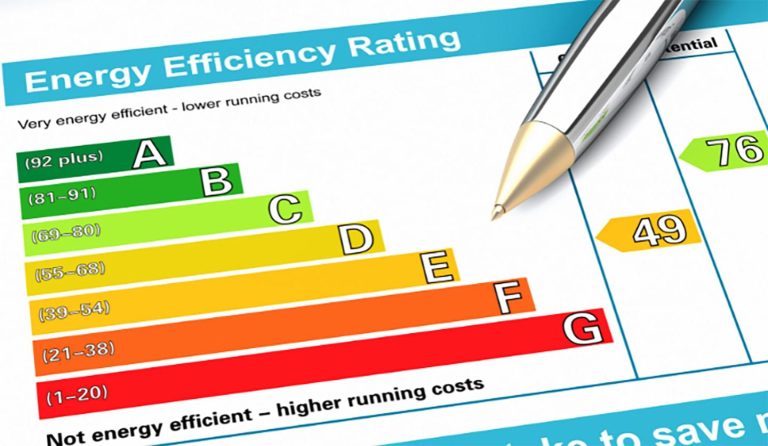
- Energy efficiency for landlords, and what Government expects them to achieve, and when.
- Planning reform.
More can be seen on the web site – ihowz.uk/campaigns.
THE FUTURE
iHowz continues to adapt, using social media to connect to younger landlords, whilst not forgetting older landlords who still prefer printed.
Onwards, and upwards for the next 50 years. Naturally, it will be impossible to predict life in 2074, especially for the PRS. It might not even exist in its current form, but we hope our descendants will be steering landlords in the late 21st Century.